Customer Success Story

Concrete Rudolph Uses Z-LASER Projectors for Precast Concrete Elements

With Z-LASER’s projection technology, Concrete Rudolph achieves faster, more precise, and more efficient alignment in precast concrete production.

Concrete

Laser Projectors

Laser Precision for the Future of Precast Concrete

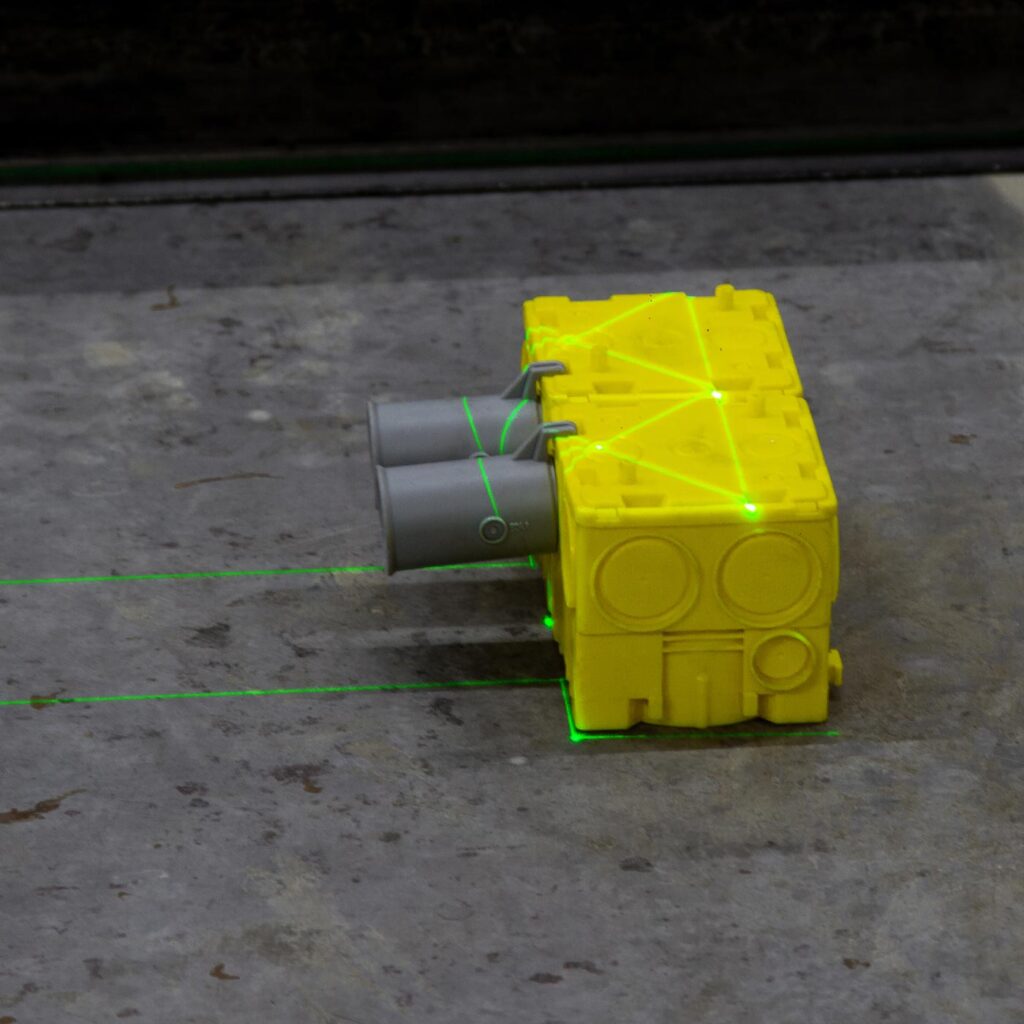
By implementing multiple Z-LASER projectors working together in a synchronized multi-projection system, Concrete Rudolph has optimized the alignment and placement of precast concrete components. Visible laser lines indicate the exact positions for formwork, reinforcement, and cut-outs, allowing for a faster, more precise, and error-resistant production process.

Challenges

In precast concrete production, elements such as formwork components, openings, and reinforcement parts must be positioned with millimeter accuracy across large surfaces. Conventional templates or manual markings were time-consuming, prone to errors, and often led to costly rework or dimensional inaccuracies. The company required a solution that could project layout data efficiently across large casting tables while maintaining absolute precision and repeatability.

Solutions

Z-LASER provided a synchronized multi-projection system that combines several laser projectors into one unified, large-scale projection. The projected laser lines show workers exactly where to place formwork, cut-outs, and reinforcement components — eliminating mechanical templates and manual marking. This significantly reduces setup time, improves positioning accuracy, and increases process safety.

Controlled via ZLP Suite software, the projectors work seamlessly together, ensuring full coverage of even the largest production tables. The result is a streamlined, digital workflow that delivers maximum precision and consistency in precast element production.

Concrete Rudolph GmbH, a leading manufacturer of precast concrete elements, focuses on high quality and production efficiency. To modernize its manufacturing process, the company implemented an advanced laser projection system from Z-LASER.

Several laser projectors are installed in a synchronized multi-projection configuration, projecting the exact reference lines for the positioning of formwork, openings, and reinforcement directly onto the casting surface. Operators can align and assemble all components precisely along the projected laser outlines — completely eliminating manual measuring or marking steps.

This solution results in significantly reduced setup times, improved accuracy, and consistently high quality across all precast products. Concrete Rudolph demonstrates how digital laser projection can transform traditional precast production into a faster, safer, and more efficient process.

Conclusion

By using the multi-projection system from Z-LASER, Concrete Rudolph has brought its precast concrete production to a new level. The technology replaces traditional marking and measuring methods with a state-of-the-art laser solution, enabling higher precision, faster workflows, and greater process reliability. This innovation is a prime example of successful digitalization in the concrete industry.