Customer Success Story

Save Time And Costs

Optimize production process of rotor blades with laser projection systems
halle weitwinkel rotorblatt perspektive zlaser

Composites

Laser Projectors

Nordex Energy SE & Co. KG, Rostock, Germany

Nordex accelerates rotor blade production with Z-LASER technology

The Nordex Group optimized its rotor blade production through the use of Z-LASER projection systems to modernize the time- and material-intensive process of laying fiberglass. Six precise laser projectors and the intuitive ZLP Suite software enable millimeter-accurate positioning of over 200 fiberglass mats per rotor blade. This reduced the production cycle time by up to three hours per rotorblade, while significantly improving manufacturing quality and process reliability. After a successful test phase, Nordex confirmed the reliability and technical maturity of the Z-LASER solutions as key factors in achieving more efficient, cost-effective, and sustainable rotor blade manufacturing.

Challenges

The greatest challenge for the Nordex Group was ensuring the precise positioning of fiberglass layers during the production of a 74-meter-long rotor blade. Previously, this was a time-consuming manual process that could hardly meet the high precision requirements in the millimeter range. Especially in the root section of the blade—where the highest structural forces occur—over 200 fiberglass mats had to be placed in 45 layers, each with exact and repeatable alignment. This task demanded significant time, skill, and concentration, while remaining prone to human error.

Herausforderung
Solutions

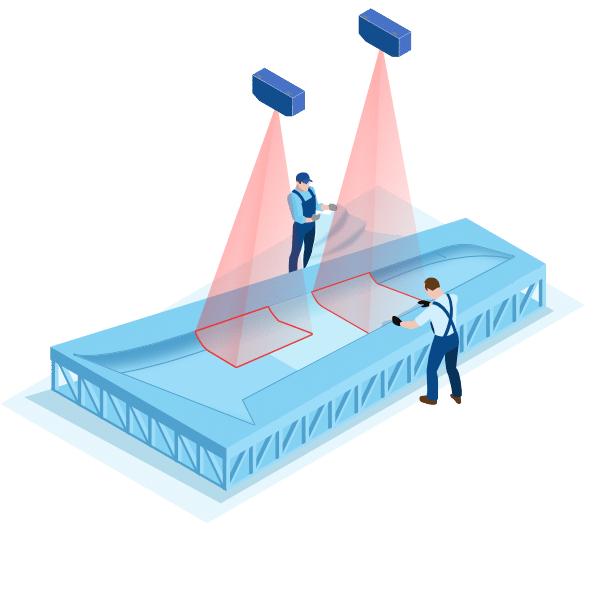
The solution was provided by Z-LASER with the ZLP2 laser projection system: six laser projectors installed above the negative mold project the exact positions of the fiberglass mats directly onto the rotor blade mold. Using the intuitive ZLP Suite software, the system was easily integrated into Nordex’s production environment. This made the process significantly faster, more precise, and more standardized—achieving a time saving of up to three hours per rotor blade, along with improved quality and reduced rework.

Lösung

“Since commissioning, large time savings have already been generated.”

Nordex Group discovered Z-LASER GmbH in its search for innovative and cost-reducing systems for this complex manufacturing process. The idea behind the process to use laser projection and positioning to achieve faster production and shorter circle times and, at the same time, greater precision. We can already reveal that up to 3 hours were saved in the production process for a rotor blade related to laying over 200 glass fibre mats.


How did this happen so quickly?


The complete manufacturing process of a blank is very complex and therefore takes a lot of time. For this reason, the use of an optical guidance system represents a process optimization with great savings potential. In order to make the production process leaner and faster, Nordex Group installed a number of laser projectors called ZLP2 from Z-LASER GmbH at a distance of about 8 m above the negative mould on the roof of the production hall. The projectors were positioned to cover approximately 90% of the suctionside mould and 40% of the pressureside mould. Workers may work in their working environment without restriction. Operation is controlled via the intuitive and easy-to-use ZLP-Suite software, which can be easily integrated into Nordex customer applications using the product‘s own programming interface, programmed by the user and may be extended on a modular basis.


The most time-consuming step in the production of a rotor blade is to cover it with glass fibre layers which, due to their size up to 20m, are divided into several patches. Most of the material is used in the so-called root area, since this is where the greatest forces are experienced once put into operations. Small tolerances must be observed when shafting this root area. In total, more than 200 individual glass fibre mats in 45 layers are laid layer by layer by hand. The ZLP2 projects the exact positions onto the workpiece so that this can be done optimally and accurately. Excess material can then be removed along the laser mark so that it does not remain in the component. In addition to the positioning of the fibre mats, many other applications where the laser projection system can be used in the production process of rotor blades were identified.

A successful collaboration - Nordex Group and Z-LASER

Since its founding in 1985, Z-LASER GmbH has been pushing the development of laser systems. Nordex Group‘s management had great confidence in the Z-LASER experts‘ experience and project planning, so that a decision was made in favour of the Freiburg-based company after a 3-month test phase.


Nordex Group, is clearly delighted with the successful use of positioning and projection laser systems in its own production: „The technical maturity of the products and the technical expertise of Z-LASER were the deciding factors for us. Even when timelines were tight, our collaboration with Z-LASER remained friendly and constructive. They delivered on what they promised 100 %. The use of Z-LASER’s laser projection system has significantly reduced throughput times for rotor blades while at the same time improving lamination quality. This means that we have come much closer to our goal of reducing process time to a minimum.

Conclusion

The manufacturing process can be significantly faster, more precise and more effective with the aid of lasers to position composite materials. Where previously the correct position of glass layers had to be determined in a complex way, today the use of laser systems sets new standards. In the manual lay-up process in particular, we can design with a relative degree of accuracy of 2 mm. Drastic cost reductions can be achieved by using lasers in production given time savings in the positioning process, ideal material consumption and minimisation of corrective work. Even the often time-consuming training of new employees becomes simple and quick because the laser system displays the work steps. Optimising manufacturing processes accompanied by increasing production quality represents forward-looking development on the path toward flexible and efficient Industry 4.0 and holds great potential for enterprises.