




The manufacture of nail plate trusses places high demands on precision, process reliability, and compliance with applicable standards. At the same time, requirements for efficiency and throughput continue to increase. However, mechanical templates or measurement systems used in conventional production are time-consuming to set up and prone to errors, particularly when handling complex or changing constructions. In addition, companies are facing a shortage of skilled labor in the wood industry, making the fast and reliable onboarding of new or less experienced employees increasingly important.
Industrial laser projectors from Z-LASER have become a key enabling technology for optimizing manufacturing processes in nail plate truss production. They project the contours of the trusses onto the work surface true to scale based on CAD data, allowing the laser lines to serve as digital templates. This reduces setup times, standardizes positioning and assembly, and ensures consistently high manufacturing quality.
Challenges in Nail Plate Truss Manufacturing
In the manufacture of nail plate trusses, rafters, struts, and purlins must be positioned with high precision and pressed together at the joints in accordance with the CAD data. Even minor deviations can lead to misalignment and result in additional rework. Especially in production environments that rely on mechanical templates or measurement systems, numerous challenges typically occur:
- High setup effort: Physical templates must be set up in a time-consuming process and repeatedly adjusted or repositioned when designs change.
- Increased risk of errors: Manual alignment, measuring, and marking increase the likelihood of measurement, transfer, and positioning errors when aligning timber members and nail plates.
- Limited flexibility: Design changes or new configurations require physical templates to be modified or newly produced, resulting in additional time and effort.
- Limited reproducibility: Consistent results are difficult to achieve, particularly for complex geometries.
- Challenging quality assurance: Errors are often only detected in later process stages (e.g., during on-site assembly), leading to corrective work.
- Shortage of skilled labor: Due to the shortage of skilled labor, companies must ensure that less experienced employees are trained quickly and reliably to avoid production errors.
Digital Laser Templates: True-to-Scale Projection of Nail Plate Trusses
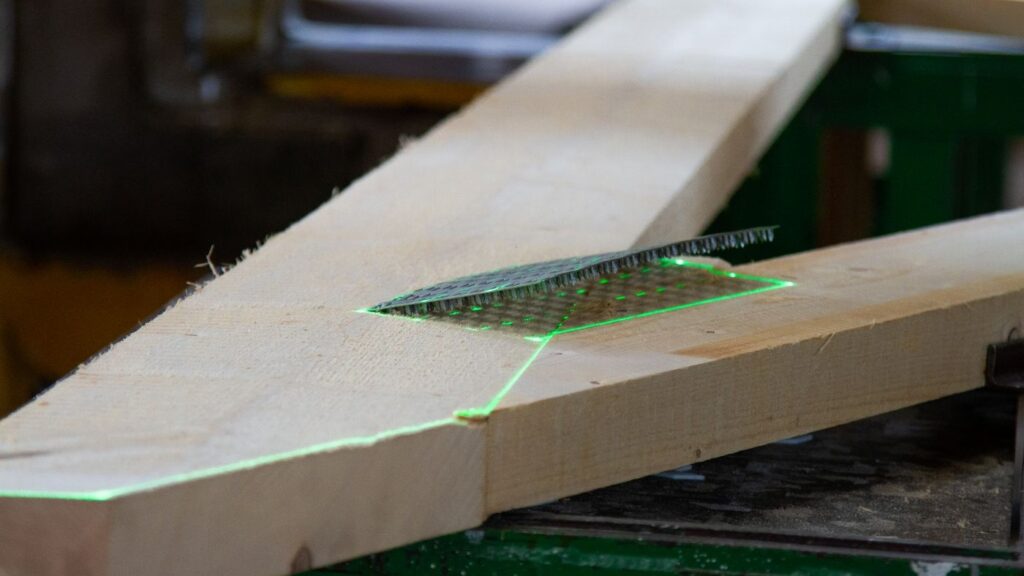
Laser projectors from Z-LASER function as optical guidance systems in the manufacture of nail plate trusses. They project the complete contour of the trusses onto the work surface at full scale based on CAD data, typically onto assembly tables or C-frame presses. This creates what is known as a digital laser template. The projected laser lines visualize the correct positioning of rafters, struts, and nail plates and also indicate the assembly sequence of the individual components. Operators can position all components quickly and precisely along the laser lines in the correct order. For large-scale structures or large work areas, up to 16 laser projectors can be combined into a synchronized multi-projector system.
Benefits of Laser Projection for Nail Plate Truss Manufacturing
The use of laser projectors in the manufacture of nail plate trusses offers significant advantages over conventional methods based on mechanical templates or measurement systems, particularly in terms of efficiency, throughput, quality, and cost-effectiveness.
Process Optimization
- Reduction of setup times by up to 70%: By projecting the nail plate trusses in advance, the positions of the tables can be determined more quickly and accurately, while the positions of fixtures and supports are simultaneously projected onto the tables. Time-consuming adjustments and corrections are largely eliminated. Overall, setup times can be reduced by up to 70%.
- Faster production and productivity gains of up to 30%: Assembly and positioning are significantly accelerated, while manual measuring, alignment, and marking are no longer required. Overall, nail plate truss manufacturers can increase productivity by approximately 20 to 30%.
- High flexibility for changing designs: New or customized designs, such as special constructions, can be implemented immediately based on CAD data, without the need to modify templates or produce new ones.
Improved Quality and Error Reduction
- Lower error rates and reduced scrap: The use of digital laser templates reduces measurement, transfer, and positioning errors. Scrap and rework are significantly reduced, while material utilization is optimized.
- Early error detection: Errors can be identified and corrected during production on the shop floor, preventing delays during on-site assembly.
- High repeatability and consistent manufacturing quality: Digital laser templates enable standardized positioning and assembly. Even for complex or highly variable geometries, reproducible results can be achieved.
- Reliable quality assurance: By using laser projectors, nail plate truss manufacturers can reliably meet the applicable requirements for nail plate products.
Cost-Effectiveness and Competitiveness
- Cost savings: Increased throughput, combined with a reduced error rate, results in significant cost savings.
- Shorter training times and support in addressing the shortage of skilled labor: New employees or temporary workers can be trained more quickly and efficiently through visual guidance.
- Strengthening competitiveness through digitization: By digitizing positioning and assembly processes using laser projectors, workflows can be made more efficient, material utilization optimized, and quality standards maintained at a consistently high level. This strengthens overall competitiveness.
Requirements for Laser Projectors in Nail PlateTruss Manufacturing
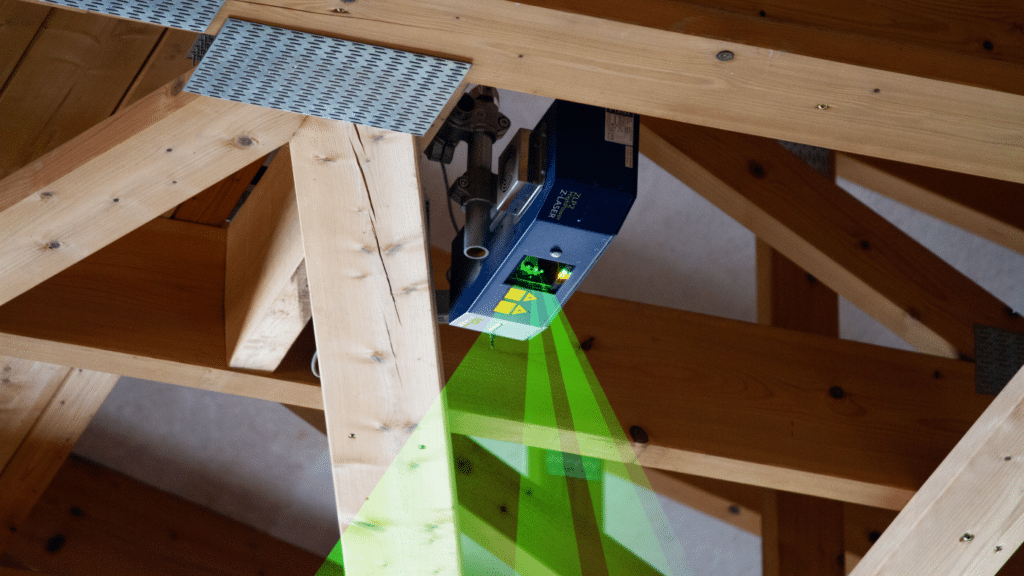
Trusses are typically manufactured in large, open production halls where laser projectors are installed, for example, above the assembly tables. In addition to changing lighting conditions and long projection distances, sawdust, wood particles, and moderate vibrations caused by sawing and pressing can affect projection quality and stability.
To operate reliably under these environmental conditions, laser projectors must meet specific technical requirements:
- High projection accuracy: Tight tolerances of approximately 1 to 2 mm across the entire work surface require highly precise and true-to-scale projection.
- Coverage of large work areas: The production of large-scale structures requires systems capable of reliably covering large spans, if necessary through the use of multi-projector systems.
- High visibility: For reliable visual guidance, the projected lines must remain clearly visible under varying lighting conditions and on different wood surfaces.
- Robust design: The environmental conditions in nail plate truss manufacturing require a durable, industrial-grade design.
- Integration into existing processes: Efficient production requires that laser projectors can be easily integrated into existing systems.
Laser projectors from Z-LASER are designed for demanding industrial applications and enable precise, efficient, and repeatable production.
ZLP2-HighPower: High-Performance Laser Projection for Nail Plate Truss Manufacturing
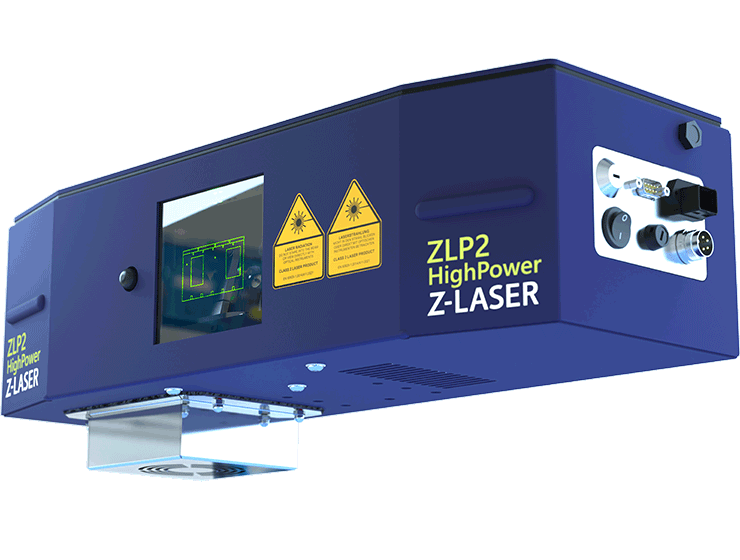
The ZLP2-HighPower is designed for demanding production environments, making it an ideal laser solution for nail plate truss manufacturing. With a projection accuracy of better than ± 0.1 mm/m, it enables precise positioning and meets high requirements for dimensional accuracy and process reliability. Green laser lines, high line brightness, fine 3D line quality, and an adjustable focus ensure clear and highly visible projections, even under challenging lighting conditions, at greater installation heights, or on varying surface materials.

ZLP2 – HighPower
The ZLP2 HighPower sets a new standard for laser projection in the most demanding environments. With an enhanced laser source, upgraded mechanics, and optimized electronics, it delivers superior brightness, precision, and durability—even in challenging light conditions or across large projection distances. Achieving an accuracy better than ±0.1 mm/m, it supports working areas up to 10 × 10 m and projection distances of up to 15 m. Typical applications include concrete construction, aerospace, and wind turbine blade manufacturing, where it can improve process efficiency by up to 30%. Its modular design allows key components to be replaced in the field in under an hour, minimizing downtime, while standardized interfaces and an intuitive API ensure seamless integration into existing systems.
Learn MoreIt is designed for projection distances of up to 20 m and work areas of up to 10 × 10 m, enabling the precise representation of large and complex structures. By combining multiple units into synchronized multi-projector systems, the projection area can be flexibly expanded. Its robust IP65-rated design ensures reliable operation, while the modular construction allows key components to be replaced directly on-site, reducing downtime to less than one hour. Standardized interfaces and an intuitive API also enable seamless integration into existing systems.
TrussFlow: New Intuitive Software for Truss Manufacturing
With TrussFlow, Z-LASER offers a new software solution specifically developed for the production of nail plate trussesthat integrates laser projection directly into the production workflow. The application serves as a user-friendly interface for operating Z-LASER laser projectors and supports operators in the structured execution of individual process steps, whether working with a single projector or within a multi-projector system.
CAD data is not only projected but also specifically prepared for production: relevant content can be displayed step by step, for example, by components or production stages. Functions such as selectively displaying specific areas, shifting or rotating projections, and defining reference points allow flexible adaptation to different production conditions. In addition, multiple trusses can be processed in sequence, while for complex geometries only the relevant sections are displayed. This ensures that the projection remains clear and focuses on the essential information.
Key Features of TrussFlow at a Glance
- Simple layer selection via on-screen buttons: Rafters, struts, and nail plates can be positioned precisely.
- Flexible visualization: The projection can be displayed either at table height or directly on the material surface.
- Flexible projection adjustment: Projections can be shifted, rotated, or mirrored.
- Definition of reference points: Multiple reference points can be defined.
- Truss stack processing: Multiple trusses can be loaded and processed sequentially.
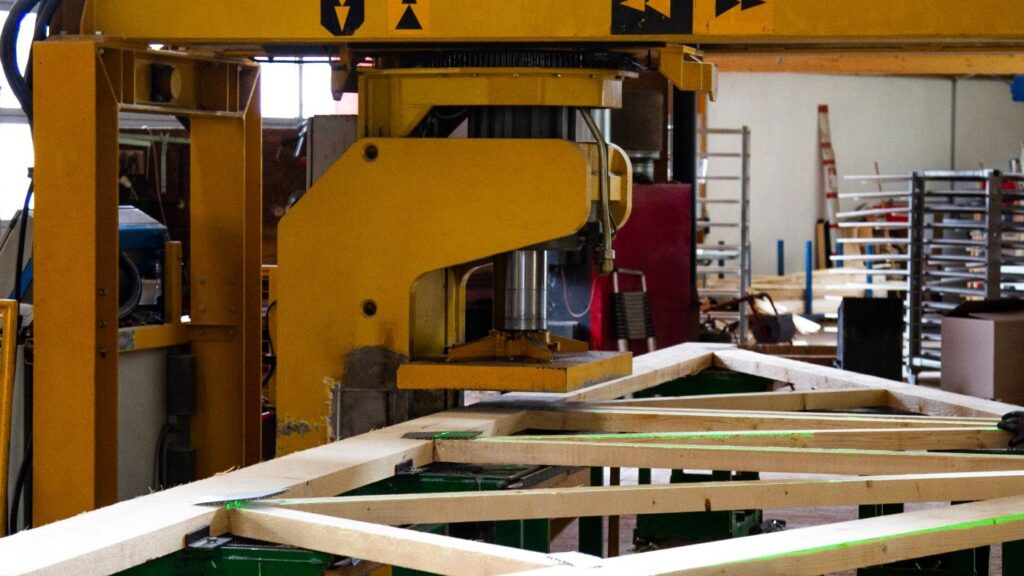
Case Study: Z-LASER Projectors Optimize Nail Plate Truss Manufacturing at Natec
The benefits of digital laser templates are demonstrated by the use of Z-LASER projectors at Natec GmbH. The company produces nail plate trusses in various sizes and formats and utilizes laser projectors in a multi-projector system. This enabled millimeter-precise positioning of all components. The digitalization of the entire positioning and assembly process has resulted in more efficient and reliable manufacturing. At Natec, setup times were significantly reduced, repeatability increased, and a consistently high level of manufacturing quality was ensured.
Maximum Efficiency and Precision in Nail Plate Truss Manufacturing with Z-LASER
The use of digital laser templates makes manufacturing processes more efficient, standardized, and reproducible. The true-to-scale projection of CAD data onto the work surface eliminates the need for error-prone mechanical templates or measurement systems. Operators can align components quickly and precisely based on visual guidance, even with changing geometries and large-scale structures. In combination with the user-friendly software TrussFlow, this enables a structured production process that minimizes errors, improves process reliability, and ensures consistently high manufacturing quality. Laser projection makes a significant contribution to increasing efficiency and cost-effectiveness in nail plate truss manufacturing.
Would you like to increase the efficiency of your production with Z-LASER? Contact us for a personal consultation on suitable laser solutions for your application.
Frequently Asked Questions
A nail plate truss is a prefabricated timber truss whose components are connected by pressed-in steel plates, known as nail plates. It is primarily used in roof constructions and enables large, column-free spans.
Laser projectors project the contours of the trusses true to scale onto the work surface based on CAD data. The projected laser lines serve as digital templates and indicate the exact positions of the components, enabling precise positioning.
Laser projectors reduce setup times and sources of error, thereby minimizing rework. Positioning and assembly processes are standardized, resulting in more efficient workflows and consistently high manufacturing quality.
The ZLP2-HighPower provides reliable visibility and high projection accuracy even across large work areas, long projection distances, and varying lighting conditions. This makes it particularly well suited for nail plate truss manufacturing.
Yes, Z-LASER laser projectors can be integrated into existing production systems and connected to existing infrastructures via standardized interfaces and APIs. They are compatible with C-frame presses and assembly tables and can also be combined into multi-projector systems.
TrussFlow is a software used to operate laser projectors in truss manufacturing. It prepares CAD data for production and guides operators step by step through the manufacturing process by displaying information required for each task.