



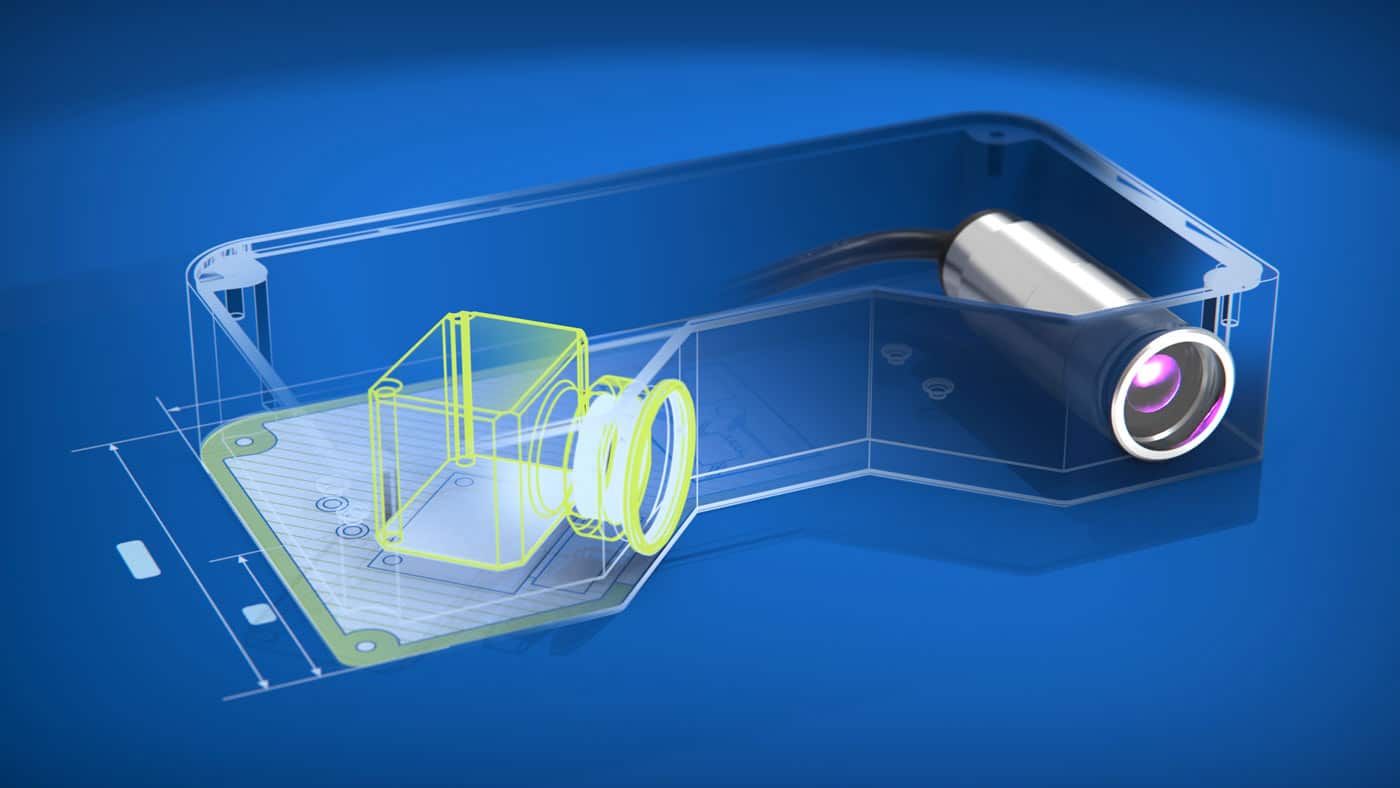

Line lasers from Z-LASER are used across a wide range of industrial applications, including woodworking, metalworking, textiles, and tire manufacturing, as well as glass, stone, and ceramics processing. They project a defined laser line onto workpieces or surfaces, making machining positions, cutting paths, or edges clearly visible. Additionally, line lasers can be integrated into machine vision measurement and inspection systems, where they serve as structured light for 3D measurement.
This article explains how line lasers work, highlights typical use cases, and outlines the practical criteria that matter when it comes to alignment, accessories, and selecting the right industrial line laser for different use cases.
Line Lasers: Operating Principle
The projected laser line is created by the interaction of a laser diode and beam-shaping optics. The laser diode generates a collimated beam, which is expanded into a line by an optical element such as a cylindrical lens or a Powell lens. This produces a geometrically defined reference line that is projected onto an object or surface. The projected line’s quality and visibility are determined by optical parameters (e.g., wavelength, output power, and the optics’ fan angle) as well as application-specific settings such as focus position and working distance. These factors influence line length, line width, and line intensity uniformity along the projected line.
In contrast to point lasers, which provide a single reference point, line lasers project a continuous line to make cut edges or alignment lines visible. Cross-line lasers project two orthogonal lines.
Working with Line Lasers: Optical Positioning Aid for Industrial Applications
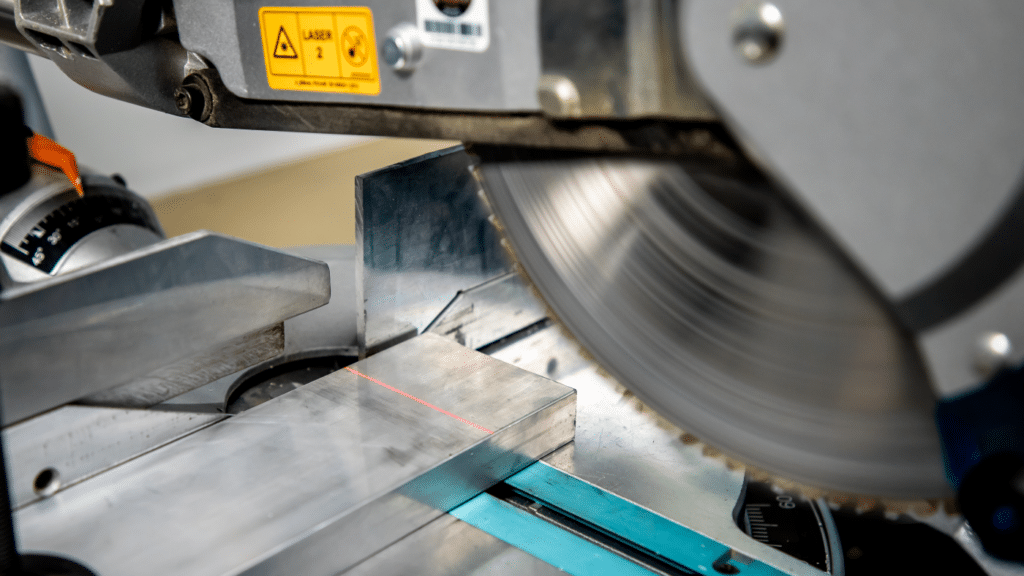
Line lasers are widely used in industrial applications as optical positioning aids. They project a clearly visible laser line directly onto the workpiece to indicate cut edges, machining positions, or alignment lines. This way, line lasers support manual operations by standardizing and streamlining positioning and alignment, helping reduce errors and improve material utilization. This also supports consistent quality.
Typical use cases for line lasers on machines can be found in the following industries and applications:
- Wood industry: Accurate display of saw and cut lines, for example, when working with a sliding table saw.
- Metal processing: Visualization of cutting, bending, and machining lines for precise fabrication.
- Textile industry: Fast and repeatable positioning of fabric webs during cutting processes.
- Tire industry: Precise alignment of material layers and components, for example, during tire building.
- Stone, glass and ceramics: Precise marking of cutting and machining lines on delicate materials.
Line Lasers in Machine Vision: Structured Light for Measurement and Inspection Systems
In optical measurement and inspection systems for machine vision, a line laser module can be used as structured illumination. A common method is laser triangulation: a laser line is projected onto an object and captured by a camera from a defined angle to derive geometric and surface information. Based on the laser line’s position in the camera image, software computes height profiles and 3D data of the object. This enables non-contact acquisition of measurement data at high resolution and speed; inspection processes can be automated, and data can be evaluated in real time.
Line lasers can be used in machine vision applications in the following industries:
- Tire industry: Used in quality control for tire manufacturing, for example, for raw material inspection.
- Electronics: Inspection and measurement of printed circuit boards (PCBs) and very small components.
- Food and beverage: Contour detection and fill-level detection for quality assurance.

Aligning and Calibrating Line Lasers
To ensure the accuracy of a laser system, it is essential to correctly align the line laser. This is done through mechanical adjustment, where the laser’s position, angle, and distance to the workpiece are set precisely. Even small deviations can lead to positional errors in the projected line. In addition to mechanical alignment, optical parameters such as focus and the optics’ fan angle must be matched to the specific application. Environmental factors such as temperature fluctuations, vibration, and changing ambient light can also affect the stability and visibility of the projection.
For demanding applications, robust mounting solutions and suitable accessories, along with defined calibration procedures, are therefore required to maintain a precise and stable line projection over the long term.
Mounting and Accessories for Line Lasers: Ensuring Stability and Accuracy
Accessories suitable for line lasers are crucial for the stability and projection accuracy of the laser line, as both depend largely on proper mechanical integration. Precision mounting brackets allow line lasers to be aligned accurately along all relevant axes. This creates the basis for stable line projection under industrial environmental conditions. It is especially important that the mount provides effective vibration damping as well as high thermal stability so the laser line reliably maintains its position even in harsh production environments. Z-LASER offers matched accessories for line lasers and supports customers from selection through integration.
Buying Line Lasers: Selection Criteria for Industrial Applications
When purchasing a line laser, the following application-specific criteria should be considered to select the appropriate solution:
- Working distance and optics (fan angle/focus): The distance to the workpiece determines which optics make sense so that the line appears at the required length and sharpness.
- Wavelength: Red line lasers are an established standard. Green line lasers are perceived much better by the human eye and are particularly suitable in high ambient light or on dark surfaces.
- Output power: It affects laser-line visibility and must be specified to ensure clear projection at the required working distance or under high ambient light.
- Line quality and focus: Straightness and homogeneity, as well as an appropriate focus at the working distance, must meet the requirements of the specific application.
- Protection class (IP): The laser must have a suitable IP rating to operate reliably under the respective environmental conditions and, for example, withstand dust, moisture, or water spray.
Industrial Line Lasers: Precise Positioning and Reliable Quality Inspection
Line lasers serve as an optical reference for positioning and alignment in industrial applications. They support precise, repeatable manufacturing processes by projecting a clearly defined reference line directly onto workpieces or process areas. This helps operators perform tasks such as cutting and assembly faster and more safely, while reducing misalignment, rework, and scrap. In industrial machine vision, the laser line of the line laser module is used as structured illumination for camera-based measurement and inspection systems in automated quality inspection. As a result, line lasers can contribute to more efficient manufacturing processes and improved cost efficiency.
Would you like to integrate line lasers optimally into your application? Our experts will be happy to advise you on selecting the right laser solution.
Frequently Asked Questions
A line laser projects a defined laser line onto surfaces, making machining positions, cut lines, or edges visible. It can also be used as structured illumination in machine vision for automated quality inspection.
A line laser projects a line and provides a linear reference for cut paths, edges, or alignment. A point laser only marks a single reference point.
A line laser is aligned by adjusting its mounting position and orientation so the projected line matches the required reference on the part. The working distance must be set correctly, and the focus must be matched to that distance. Precision mounts are commonly used because they allow fine adjustment in several axes.
Yes. Z-LASER line lasers are suitable for retrofitting existing production equipment. Key factors include housing design, working distance, the mounting situation, and the appropriate accessories.
The appropriate wavelength depends on the material, ambient light, and the application. Red and green lasers are commonly used. Green lasers are perceived much better by the human eye and are therefore well suited, for example, for manual alignment and positioning tasks in high ambient light or on dark, low-contrast surfaces.
Line lasers serve as structured illumination and, in combination with a camera and machine vision software, enable 3D profile measurements and contour detection for automated quality inspection.